
Ever stood in a grocery store line and thought, “How do they know which milk I’m buying first”? In inventory accounting, FIFO and LIFO methods answer that same question, but for your stock. FIFO means you sell the oldest items first, while LIFO means you sell the newest items first.
This matters when prices change. If you buy the same product at different costs, FIFO and LIFO can change your cost of goods sold, your reported profit, and the taxes you may owe. For many small businesses, those numbers can affect decisions in real time, not just paperwork.
In addition, these methods can shift what shows up on your balance sheet as inventory value. As a result, you need a clear rule for choosing the right approach and staying consistent.
Next, you’ll see exactly how FIFO and LIFO work, then you’ll compare differences, pros and cons, and the practical tax impact so you can pick what fits your business.
How FIFO Works? First In, First Out Made Easy
FIFO method explained simply: First In, First Out is like a coffee shop queue. The first cup the barista pours is the first cup you get served, even if new orders come in right after. Inventory works the same way. FIFO assumes the oldest items you bought get sold first.
When prices rise, that choice has a big effect. Older items usually cost less. So FIFO often shows lower costs sold (COGS), while your ending inventory stays higher because it includes newer, pricier items.
It also tends to match what you actually do in everyday life. If you sell something that can spoil, like food, or something that can go out of date, like certain supplies, you don’t want the newest stock sitting in back forever. You rotate it out. That real-world habit lines up with FIFO.
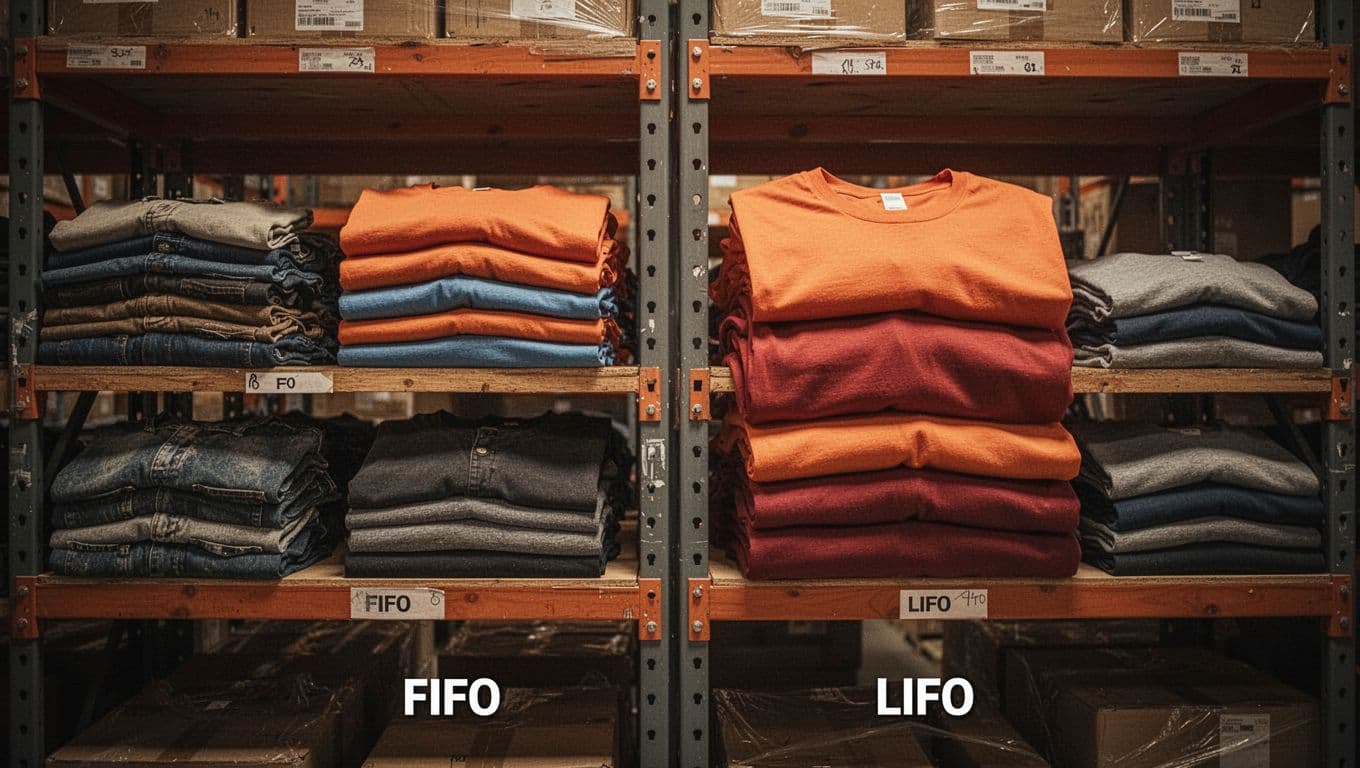
Here’s a simple “mental diagram” you can picture:
- Think of inventory like a line of shirt stacks.
- The front stack is the oldest batch (sold first).
- The back stack is newest (stays on your books longer).
That’s the core idea, and it’s why FIFO is so popular. It’s easier to track in your head, and it often gives a clearer view of what your shelves would look like near the end of the period.
One more reason it matters: FIFO can change your reported profit. With rising prices, lower COGS usually means higher profit. That can also affect how much tax you owe, depending on your situation.
Ever wonder why your grocery bill feels right, but your accounting numbers feel “off”? FIFO is often the missing link between what you pay today and what your books say you sold.
Real-Life Example: FIFO with Rising Shirt Prices
Let’s put numbers to FIFO with a real scenario. Imagine you buy plain t-shirts three times, and the price keeps going up.
You purchase:
- 10 shirts at $1 each
- 10 shirts at $2 each
- 10 shirts at $3 each
Now you sell 15 shirts. Under FIFO, you sell from the oldest shirts first, like serving the first people in line.
Step 1: Sell the oldest batch first
First, you take the 10 shirts from the $1 batch.
- Cost of those 10 shirts = 10 × $1 = $10
Step 2: Use the next batch for the rest
You sold 15 total, so you still need 5 more shirts.
Those come from the $2 batch.
- Cost of 5 shirts at $2 = 5 × $2 = $10
Step 3: Add up your total COGS
So your cost of goods sold is:
- COGS = $10 (from $1 shirts) + $10 (from $2 shirts) = $20
Now let’s figure out what’s left in inventory.
Step 4: Determine ending inventory
You started with 30 shirts total. You sold 15, so 15 remain.
What’s left after FIFO sales?
- From the $1 batch: you sold all 10, so 0 left
- From the $2 batch: you sold 5, so 5 left
- From the $3 batch: you didn’t touch it, so 10 left
Now value the ending inventory:
- $2 shirts remaining: 5 × $2 = $10
- $3 shirts remaining: 10 × $3 = $30
So your ending inventory value is:
- Ending Inventory = $10 + $30 = $40

So what’s the outcome in plain terms? FIFO puts cheaper costs into COGS when prices rise. Meanwhile, your ending inventory holds newer, higher prices. That’s why FIFO often shows lower costs sold and higher inventory value during inflation.
And if you’ve seen prices drift upward lately, you’ve basically lived this pattern. Recent inflation is running around 2.4% year over year (February 2026). Even when inflation is moderate, your suppliers can still raise unit costs over time, which feeds into the “older cheap” versus “new expensive” math. For a deeper look at how businesses think about these costing methods, see Inventory valuation methods for cost accounting.
FIFO matches the real flow of stock for many items, especially when you rotate what you bought first.
If you’re curious how this shows up in real bookkeeping, compare it to a store drawer where the newest shirts sit behind the oldest ones. FIFO clears out the front row first, then leaves the back row to represent what you still have.
LIFO Example: Same Shirts, Totally Different Results
Let’s repeat the shirt story, because LIFO inventory method results show up fast when prices rise. Under FIFO, you sold the oldest shirts first. Now imagine the opposite move: you grab from the newest stack first, like someone pulling the freshest loaf off the top.
Here’s the same purchases and the same sales mix:
- You buy 10 shirts at $1
- You buy 10 shirts at $2
- You buy 10 shirts at $3
- Then you sell 15 shirts
Now picture the stacks in the back room. Under LIFO, the back pile (newest shirts) gets picked first. As a result, your COGS reflects the higher, more recent purchase costs.
Step-by-step: LIFO COGS (the flip happens here)
Follow the flow like you’re counting shirts one batch at a time:
- Sell the newest batch first
You sell the $3 shirts first. You can sell all 10 of them.- COGS from $3 shirts: 10 × $3 = $30
- Then use the next-newest batch
You still need 5 more shirts to reach 15 total.
Those come from the $2 shirts batch.- COGS from $2 shirts: 5 × $2 = $10
- Total your LIFO cost of goods sold
- COGS = $30 + $10 = $40
So compared to FIFO, your COGS jumps. That jump matters because it hits your profit right away.
What happens to ending inventory?
Ending inventory flips too. Under LIFO, the oldest shirts stick around longer on your books, because you sold the newer ones first.
After selling 15 shirts:
- From the $3 batch, you sold all 10, so 0 left
- From the $2 batch, you sold 5, so 5 left
- From the $1 batch, you sold none, so 10 left
Now value the ending inventory:
- $2 shirts remaining: 5 × $2 = $10
- $1 shirts remaining: 10 × $1 = $10
- Ending inventory = $10 + $10 = $20
| Method | COGS | Ending Inventory |
|---|---|---|
| FIFO | $20 | $40 |
| LIFO | $40 | $20 |
That’s the core LIFO inventory method story in one glance: higher COGS, lower ending inventory when prices rise.
In inflation, LIFO often matches current costs with current sales, which can reduce taxable income.
Also, this approach shows up mainly in the US because IFRS bans LIFO. If you want a plain-English look at how companies treat LIFO, see Last In, First Out (LIFO) explained. For a tax-focused view of why companies still care about LIFO, Understanding LIFO tax treatment is a good reference point.
FIFO vs LIFO: What Changes for Your Profits and Taxes?
FIFO vs LIFO differences show up fast when your purchase prices move over time. The methods don’t change how many units you sold, but they change which cost layers you treat as “sold” versus “still on hand.” That swap reshapes COGS, gross profit, ending inventory, and then flows into your tax bill.
In plain terms, think of inventory like building blocks in a box. FIFO grabs the oldest blocks first, LIFO grabs the newest blocks first. If newer blocks cost more, your numbers will look different even if the units sold stay the same.
How They Impact Cost of Goods Sold and Inventory
Start with the basic mechanic: FIFO matches older costs to sales first. LIFO matches newer costs to sales first. Because of that, inflation usually pushes FIFO and LIFO in opposite directions.
Here’s the usual pattern when prices rise:
- COGS (FIFO low, LIFO high): FIFO pulls cheaper layers into COGS. LIFO pulls pricier layers into COGS.
- Ending inventory value (FIFO high, LIFO low): FIFO leaves newer, higher-cost inventory on the books. LIFO leaves older, lower-cost inventory on the books.
That’s why two companies can report different profits from the same sales. Same units sold. Different cost layers assigned.
Now connect that to “profit picture.” If LIFO makes COGS higher, gross profit drops. With FIFO, COGS is lower, so gross profit rises. The difference comes from timing, not from how well you ran your business.
Let’s make it feel like a movie scene. Picture inflation as a rising tide. FIFO shows you the tide receding in COGS, while LIFO shows you the tide rising in COGS. Meanwhile, ending inventory shows the opposite view. FIFO leaves you standing on “higher ground” (higher inventory dollars). LIFO leaves you on “lower ground” (lower inventory dollars).
If you want a quick reference for how the methods affect financial reporting, FIFO vs. LIFO: Financial and Tax Impacts Explained breaks down the core logic in straightforward terms. Use it as a sanity check against your own calculations.
A small gotcha matters, too. Even when profits match in the long run, the timing changes. FIFO and LIFO can shift your story from one period to the next, especially when purchases keep changing month to month.
Finally, remember inventory valuation affects more than taxes. It can influence how lenders view working capital. It can also change what you think your margin really is during rising prices. That’s why FIFO vs LIFO differences are such a big deal for planning.
Tax Savings and Profit Picture in Real Inflation
In the US, taxes care about taxable income, and taxable income starts with the numbers you report for COGS. That’s where LIFO often turns into real tax savings during inflation. When you use LIFO, your COGS tends to be higher because newer, higher costs hit the income statement sooner. As a result, taxable income usually goes down.
If you’re wondering how this works in practice, the link between accounting and taxes is simpler than it sounds. Higher COGS means lower gross profit. Lower gross profit means less taxable income. Less taxable income means a smaller tax bill, at least for that year.
However, timing is the whole story. LIFO usually reduces taxes in high-price periods. Later, when prices stabilize or fall, the direction can shift. That’s why some owners say LIFO “moves taxes to the future” rather than eliminating them.
Here’s a clean comparison for a rising-price year:
- COGS: FIFO lowers COGS, LIFO raises COGS
- Profits during inflation: FIFO shows higher profits, LIFO shows lower profits
- Tax result: FIFO often leads to higher taxable income, LIFO often leads to lower taxable income
That shift can help cash flow. In a tight year, lower taxes can mean you keep more cash for payroll, rent, or restocking. Yet your reported ending inventory will often be lower under LIFO, which can change how your balance sheet looks.
Now for the IRS part. The IRS has a conformity rule tied to LIFO. If you use LIFO for tax purposes, you generally must also use LIFO for the financial statements you provide under US GAAP to shareholders, banks, or creditors. The practical point is this: you can’t freely mix methods across reporting without creating risk of losing tax benefits.
For adoption and switching, businesses typically use IRS procedures such as filing Form 970 to adopt LIFO. If you change LIFO methods, Form 3115 may come into play. Importantly, sources covering 2026 reporting confirm there’s no change in the core LIFO conformity rule for 2026.
As you think about the “profit picture,” also connect it to what inflation does right now. Recent CPI data put inflation around 2.4% year over year for February 2026, with core inflation near 2.5%. Those kinds of trends mean your newest inventory batches can cost noticeably more over time. So the cost layers you assign with FIFO vs LIFO can swing your tax outcome even if sales stay steady. (If your suppliers change prices in bursts, the swing is even sharper.)
To sanity-check whether LIFO or FIFO fits your tax goals, Is LIFO or FIFO Better for Taxes? offers a helpful breakdown of why LIFO often lowers taxable income during rising prices.
One more point: tax savings depend on your specific inventory flow. If you’re selling through stock fast, the “newer layer hits COGS sooner,” which can amplify LIFO’s effect. If you buy in small amounts and rotate slowly, the impact spreads out.
Bottom line for this subsection: in inflation, LIFO usually lowers taxable income by pushing higher, newer costs into COGS. FIFO usually shows higher taxable income by pushing older, lower costs into COGS. Either way, over long stretches, totals can converge, but the year-by-year profit and tax story can be very different.
Pros, Cons, and Where Businesses Pick FIFO or LIFO
When you pick an inventory method, you are choosing how your accounting tells the story of “what sold” versus “what’s still on the shelf.” FIFO and LIFO both do the same basic job, but their assumptions lead to very different FIFO LIFO pros cons results, especially when prices move up or down. So, your industry fit matters, and so does the reporting rule set you follow.
Best Industries for FIFO and Why It Wins Globally
FIFO tends to win wherever products have a real “age” to them. For perishables, rotation is normal, so the accounting flow feels familiar. In practice, FIFO matches the way many businesses already handle stock: the oldest goods go out first to avoid waste and spoilage.
It’s also the global default. Under IFRS, companies generally cannot use LIFO, which means FIFO becomes the easy choice for groups that report internationally. If you want one method that fits most markets, FIFO usually reduces friction.
Common FIFO-friendly industries include:
- Groceries and food (dairy, produce, prepared foods), because dates and spoilage drive real movement
- Fashion and apparel (seasonal items), because newer inventory has a short shelf life
- Wholesale and distribution, where fast turnover makes “oldest first” a practical fit
- E-commerce brands, especially when returns and replenishment create constant batch flow
Here’s the simple pros and cons view.
FIFO pros
- Natural flow that matches real picking and rotation
- Easier to explain to teams and stakeholders
- Often produces higher ending inventory during rising prices
- Usually fits global reporting without extra work
FIFO cons
- During inflation, FIFO can show higher taxable income (because COGS can be lower)
- It may keep newer, higher-cost units on the balance sheet, which some owners dislike
For a real-world “why it works” angle, see FIFO used in inventory cost accounting. It lines up with the practical reason many businesses pick FIFO: it keeps inventory age aligned with how products move.

LIFO’s Niche: US Tax Edge and Where It’s Not Allowed
LIFO has a smaller comfort zone. In the US, it can create a tax advantage in inflation because it puts newer, higher costs into COGS sooner. That usually lowers reported profit for the period, which can reduce taxable income.
In other words, LIFO can help you avoid the “phantom profit” feel that hits during rising prices. If your revenue reflects today’s sales but your COGS reflects older, cheaper buys, taxes can jump even when your cash situation doesn’t. LIFO swaps that timing.
Still, LIFO has trade-offs, and some rules limit where you can use it.
LIFO pros
- Tax savings potential during rising prices (higher COGS, lower taxable income)
- Better matching of recent costs to recent sales in inflationary periods
- Common among larger US firms that already track layers closely
LIFO cons
- Outdated inventory on the books when prices rise (older costs remain in ending inventory)
- More complex recordkeeping and calculations
- It can make financial results harder to compare across companies that use FIFO
Important constraint: outside the US, LIFO often fails the rules. IFRS generally bans LIFO, so businesses that report under IFRS usually stick with FIFO for consistency.
Also, the US trend is shifting away from LIFO. Recent reporting shows only a small slice of US public companies still use it, and the number keeps shrinking as firms move to FIFO for simplicity and global alignment. For a current look at why LIFO adoption is still on people’s minds, but not growing, read Why LIFO, why now?.
So where does LIFO actually fit best? Pick it when you are a US-focused business with strong reasons to manage taxes during inflation, and you can handle the complexity. Otherwise, FIFO often stays the easiest path, especially if you operate globally.
Conclusion
FIFO and LIFO are simple ways to assign costs to inventory, especially when prices move up or down. FIFO uses the oldest costs first, so it often keeps ending inventory higher during rising prices. LIFO uses the newest costs first, so it often raises cost of goods sold and can lower taxable income in the US when inflation runs hot.
If you want the cleanest records and less friction across teams (and across countries), pick FIFO for simplicity and global reporting. If your business is US-based and you’re aiming to manage taxes during price spikes, LIFO can fit, but it usually takes more care and solid documentation.
Your next step is practical. Talk with your accountant, then choose the method that matches how you buy, how you sell, and how you report, and commit to it consistently. Which method matches your inventory flow best, FIFO or LIFO? Also, review related guidance like Is LIFO or FIFO Better for Taxes? before you finalize your plan.