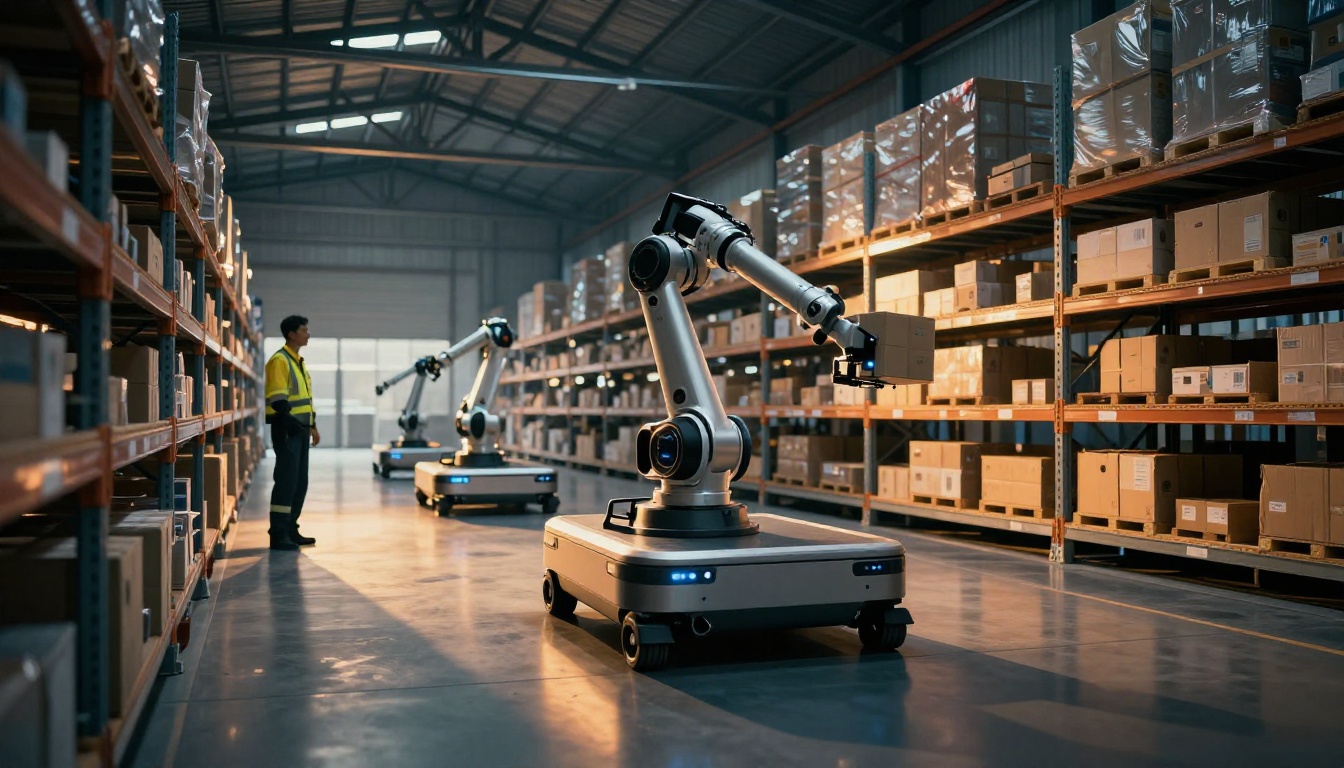
Walk into a modern warehouse and you might see robots doing the boring parts. In 2026, there are roughly 4.28 million to 4.69 million commercial warehouse robots in operation worldwide, spread across around 50,000 robotic warehouses. Since 2019, the number of robotic warehouses has grown from about 4,000 to about 50,000.
That shift didn’t happen by accident. E-commerce keeps pushing faster delivery expectations, while labor shortages make it harder to staff every shift. So warehouse automation started moving from “nice to have” to “how we stay on time.”
In plain terms, robots in warehouses handle picking support, moving goods, storing inventory, and routing items between zones. Humans still matter, but robots absorb the repetitive work and help reduce missed steps.
This article breaks down the main types of warehouse robots, the real benefits you can measure, and the tradeoffs that show up during rollout. You’ll also see real-world examples and a practical way to plan next steps. Ready to see how they work?
Discover the Main Types of Robots Powering Modern Warehouses
Warehouse automation isn’t one machine. It’s a set of tools that work together. Some robots move. Some store. Some “see” items. Some do the final handling near packing.
A helpful way to think about it: robots are like a smart crew. Each one has a job, and the software coordinates the tasks so orders flow.
Here’s a quick comparison of common robot categories and what they’re best at:
| Robot or system type | Main job in the warehouse |
|---|---|
| Autonomous Mobile Robots (AMRs) | Move totes, bins, or carts between picking, packing, and storage |
| Collaborative robots (cobots) | Work safely with people on tasks like sorting, kitting, and light assembly |
| Robotic arms | Pick, place, palletize, and depalletize with strong reach and repeatability |
| AS/RS (automated storage and retrieval) | Store and retrieve items using automated shuttles and racks |
| AI vision systems | Identify product types, labels, or irregular shapes to guide handling |
If you’re comparing storage approaches, it helps to look at how cube storage, shuttle systems, and AMRs differ in daily operations. This guide lays out the tradeoffs clearly: Cube Storage vs. Shuttle Systems vs. AMRs.
Autonomous Mobile Robots: Moving Goods Without a Human Driver
AMRs (and similar ACRs) are the robots that “drive” around the warehouse. They don’t need a fixed rail or conveyor path. Instead, they use navigation tools and route planning to move items safely between stations.
Most AMRs handle tasks like:
- Carrying totes or bins from storage to picking points
- Transporting packed orders to staging areas
- Rebalancing inventory flow during high-volume spikes
- Supporting hybrid layouts with both fixed and flexible assets
Because the robots move, the picking area can stay more human-friendly. Workers pick faster when items arrive consistently, not when they chase them across the floor.
In 2026 deployments, indoor navigation often relies on maps, sensor data, and “indoor GPS”-style localization. Some systems also use AI to respond to changes, like temporary obstructions or congestion near popular picking zones.
AMR platforms also connect to warehouse software so tasks get assigned in real time. For example, Locus Robotics has built products designed around adaptive routing and picking station workflows, which shows up in how teams design station layouts.
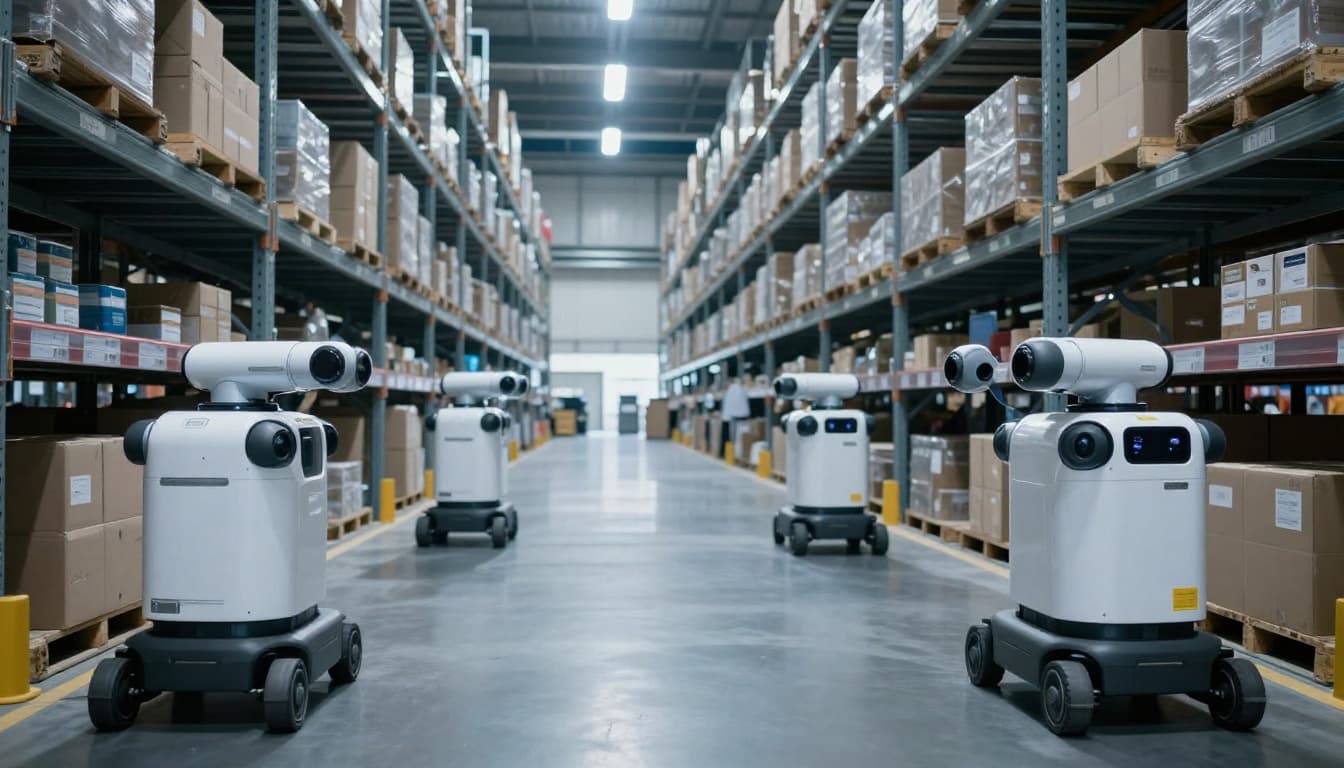
Caption: AMRs keep goods moving, even when foot traffic and order volume surge.
If you run a facility that changes layouts often, AMRs usually fit better than fully fixed automation. However, you still need clean floor paths, clear safety rules, and good data about where inventory should go.
Cobots and Robotic Arms: Safe Partners for Precision Tasks
Cobots and robotic arms handle tasks that need repeatable motion. They’re also a big reason warehouses can reduce errors without slowing down.
A cobot is built for working near people. It typically uses force limits and safety features so it can pause or stop when something gets too close. That matters in warehouses because human roles often shift through the day.
Common cobot uses include:
- Kitting (grouping parts into sets)
- Simple sorting and light assembly
- Labeling support or re-pack tasks
- Assisting with QC steps where humans want extra consistency
Robotic arms, on the other hand, are usually best when you need stronger reach and more precise manipulation. They can handle things like:
- Palletizing and depalletizing
- Picking items from mixed locations
- Loading cartons onto conveyors or trucks
- Placing irregular items with the help of vision systems
Cobots and arms work especially well when paired with good station design. If items arrive in a predictable format, robots can move faster with fewer “recovery” cycles.
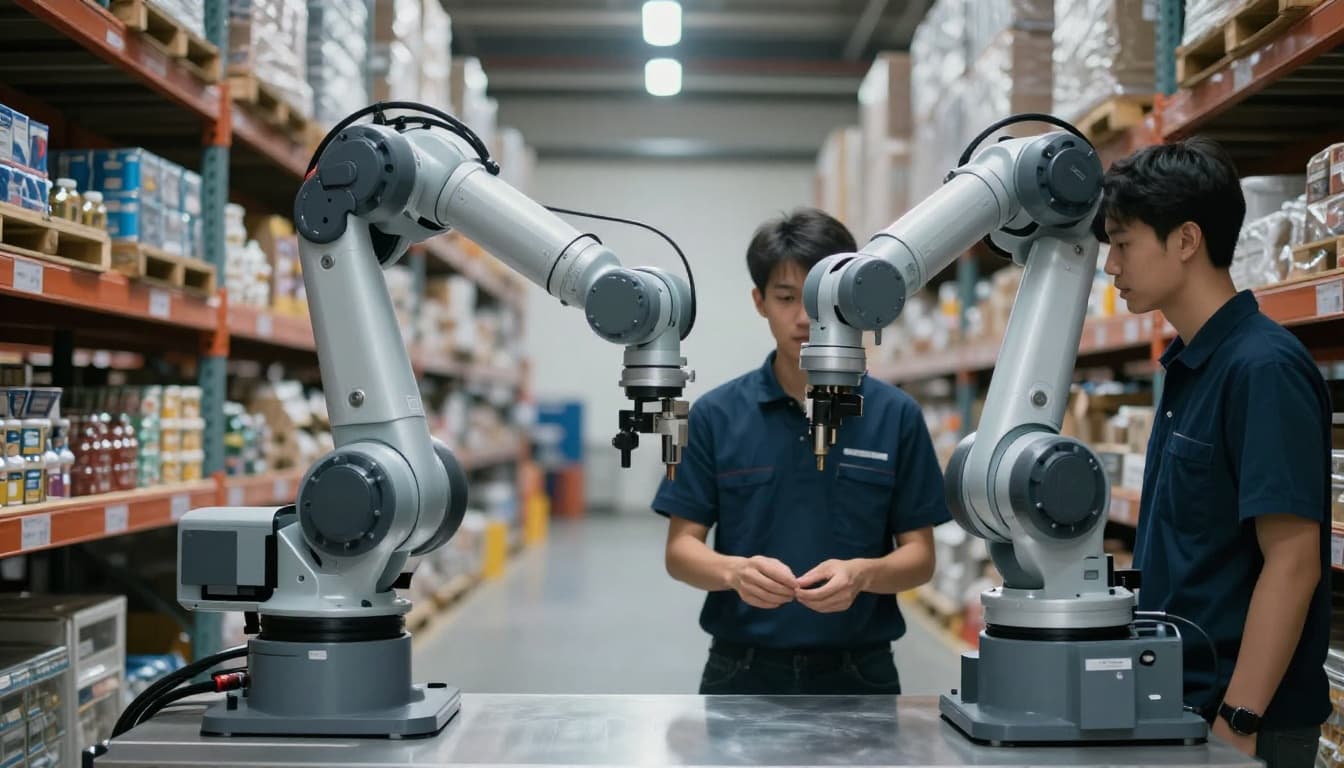
Caption: Cobots support people, while robotic arms handle heavy or precise handling.
AS/RS and AI Vision: Smart Storage and Picking Solutions
AS/RS (Automated Storage and Retrieval Systems) takes care of the storage challenge. Instead of relying on humans to walk, search, and fetch, AS/RS retrieves items automatically using shuttles or similar mechanisms.
These systems shine when:
- You have many SKUs
- You need fast retrieval at high volume
- You want tighter inventory control
- You’re building or redesigning for faster throughput
Then there’s AI vision. Vision helps when items vary in size, shape, or packaging. Instead of relying only on a barcode scan, vision can confirm the label, estimate orientation, and guide the next handling move.
This matters most in mixed-item warehouses. If you ship different product types, robotic grippers alone can struggle. AI vision fills the gap by helping the system adapt in real time.
You’ll also see vision paired with automated picking workflows in micro-fulfillment style operations, where speed comes from reducing steps between order capture and pack-out.
Unlock Huge Benefits: Speed, Accuracy, and Cost Savings from Warehouse Robots
Robots don’t just look modern. They change the math of fulfillment.
Multiple industry reports point to similar outcomes: faster order flow, fewer picking mistakes, and lower labor pressure. For example, Warehouse Automation Statistics (2026) – Sellers Commerce highlights improvements like 300% faster order fulfillment, accuracy approaching 99%, and 25–30% reductions in labor costs from automation.
These are the areas you should care about, because they affect service levels and margins.
Here’s a simple snapshot of the types of impacts teams often track:
| Benefit | Typical warehouse impact |
|---|---|
| Speed | Up to 300% faster order fulfillment |
| Accuracy | Accuracy often approaching 99% |
| Labor cost | Roughly 25–30% cost savings |
| Fewer errors | Fewer mispicks through consistent handling |
One reason results can be so strong is that robots handle the repetitive flow steps. That reduces the “human fatigue factor,” like rushed scans or skipped motions.
Software also matters. Many robots rely on a Warehouse Execution System (WES) or similar orchestration layer. That’s where the warehouse plans which tasks happen first, how routes change, and how stations communicate.
Skyrocket Your Order Speed and Cut Errors Dramatically
Speed doesn’t come from one robot. It comes from coordination.
When AMRs move goods to pickers consistently, cycle time shrinks. When arms and AS/RS retrieve items on schedule, packing stations don’t starve. Meanwhile, AI vision can reduce rework when product orientation or packaging varies.
Accuracy improves for two reasons. First, robots repeat the same actions the same way. Second, systems can check data continuously during the workflow.
Some teams also reduce cycle time by redesigning accuracy checks. Locus Robotics has discussed how rethinking warehouse accuracy can lower friction in fulfillment processes, based on customer outcomes described in its content: Designing Warehouse Accuracy for Reduced Cycle Time.
The biggest “gotcha” is not the robot hardware. It’s inconsistent inventory data and unclear picking rules.
If your SKUs move around a lot, accuracy depends on how you manage locations, labels, and exceptions. Robots won’t fix broken processes on day one. They will expose them quickly.
Save on Labor While Keeping Your Team Happier
Robots don’t eliminate people. They remove the most exhausting parts of the job.
Instead of walking miles for replenishment, workers focus on checks, problem solving, and exception handling. That can improve job satisfaction, especially in warehouses where turnover has been high.
Many deployments target labor savings in two ways:
- Reduce physical movement (transport, replenishment, and retrieval)
- Reduce rework (fewer mispicks and fewer “fix it later” steps)
Labor cost savings of 25–30% show up in multiple reports, but the better long-term goal is stability. When volume spikes, robots can keep flow steady. People can keep their attention where it matters most.
Real Success Stories, Challenges, and Top Companies Leading the Way
Automation stories are everywhere now, but your setup matters more than someone else’s success headline.
The best case studies share the same pattern. Teams start with a clear target, often one workflow that causes delays or errors. Then they build the environment that robots need, like storage layouts, routing rules, and scan quality.
Some robotics leaders, like Locus Robotics, publish detailed warehouse automation updates about real deployments and how teams adapt workflows. If you want a broad view of players in the space, Standard Bots keeps an updated list of warehouse robotics companies: Top 12 warehouse robotics companies in 2026.
Inspiring Examples from EVERSANA and Fast UK Fulfillment Centers
Instead of chasing exact promises, focus on what these examples show about workflow design.
For instance, Locus Robotics describes high-volume fulfillment with robots working alongside warehouse associates. In one described scenario, an associate retrieves an item while a Locus Origin robot carries it to the next station, so the order keeps moving without bottlenecks. You can see that kind of workflow narrative here: Seven Billion Picks in Warehouse Automation.
Even though every warehouse differs, the lesson stays the same. Robots perform best when the picking stations and transport flow are built as one system.
If you’re in regulated or high-scrutiny environments, the same principle applies. Clear handling rules and strong QA steps matter. Automation can still help, but it has to fit your process, not fight it.
Overcoming Common Hurdles Like Costs and Integration
The hard parts usually show up before robots ever move a box.
Common challenges include:
- Setup costs (especially when the warehouse needs layout changes)
- Retrofitting old spaces (floor markings, safe routes, sensor placement)
- Integration work (connecting to WMS/WES and master data systems)
- Training (so teams know how to handle exceptions fast)
- Messy areas (like damaged packaging, unstable pallets, or mixed cartons)
A practical way to reduce risk is to plan in layers. Start with robots that solve a specific bottleneck. For example, add AMRs to improve transport before you automate every picking step. Then expand once your data quality and station rules hold up in daily operations.
Also, don’t ignore software and maintenance. Predictive maintenance can reduce downtime, but only if you track robot health and keep parts schedules realistic.
If you rush the pilot, you’ll blame the robot for problems caused by messy data.
Finally, build a feedback loop. When pickers report recurring edge cases, treat those as requirements for configuration changes, not just “user error.”
The Bright Future: Self-Running Warehouses by Late 2026 and Beyond
By late 2026, more warehouses will look less like a set of machines and more like a controlled system of roles.
You’ll see more agent-like software decisions, where systems assign tasks based on current congestion, inventory position, and station availability. You’ll also see more Robots-to-Goods (R2G) approaches, where robots bring items to packers instead of making people walk for every order. That shift directly supports higher throughput and faster response during surges.
In addition, automation will move upstream. Expect more inbound flow automation for receiving and sorting, plus better coordination with outbound loading. That matters because trucks still set the pace. If loading falls behind, faster picking won’t save the schedule.
For small and mid-size businesses, the biggest shift will be affordability and modular deployments. Cobots and flexible robot cells can start smaller than full conveyor systems. Over time, those cells can expand as demand grows.
The likely end state is not “humans replaced by robots.” It’s humans paired with robots, with software coordinating both. The warehouses that win will be the ones that treat automation like a workflow redesign, not a hardware swap.
Conclusion
Robots in warehouses play a clear role: they move goods, store inventory, and handle precise tasks so orders flow faster. AMRs reduce travel time, cobots and robotic arms improve repeatability, and AS/RS plus AI vision reduce bottlenecks in storage and picking.
The payoff is measurable. Warehouses often report 300% faster fulfillment, accuracy near 99%, and 25–30% labor cost reductions when automation targets the right workflow.
Real results come from pairing the right robot type with clean data, solid station design, and fast exception handling. If you want to follow that path, start by assessing your biggest delay points and run a focused pilot.
What part of your warehouse feels slow or error-prone today, picking, transport, storage, or pack-out?